

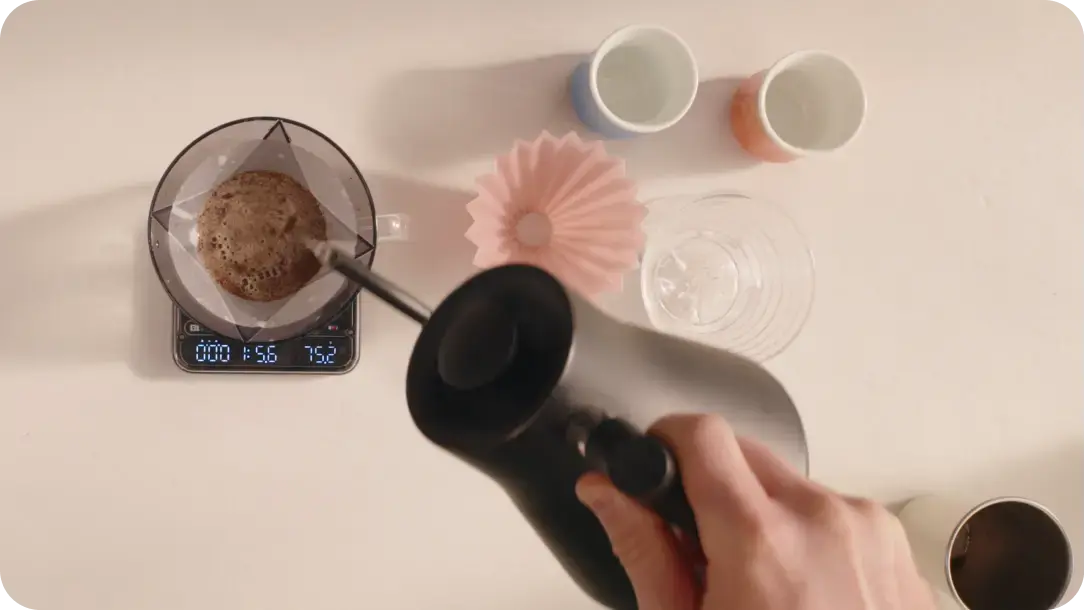
Choosing the right pour over coffee scale is the first step toward brewing like a pro. Unlike immersion methods, every gram of water changes your extraction.
Many beginners focus only on the beans. However, the secret to a balanced cup is the brew ratio. Eyeballing your water level usually leads to bitter or sour coffee. Consequently, a dedicated scale gives you total control. It tracks your pour speed and total weight in real-time.
This guide helps you find the perfect model for your home coffee bar.
1. Why Your Kitchen Scale Isn't Cutting It
Most standard kitchen scales measure in 1-gram increments. While this is fine for baking a cake, it's too blunt for coffee. A 1-gram variance in your coffee dose (roughly 5-7 beans) can drastically change the extraction and taste.
Furthermore, coffee brewing is a dance between weight and time. A dedicated coffee scale integrates these two variables, allowing you to monitor your brew ratio and your contact time simultaneously without juggling a separate phone timer with wet hands.

2. The "Must-Have" Features for a Pour-Over Coffee Scale
To elevate your home brewing, your scale must meet these four criteria:
-
0.1g Accuracy: Precision is non-negotiable. You need to know exactly when you've hit 15.0g of coffee or 250.0g of water.
-
Built-in Timer: Tracking the "bloom" (the initial 30 seconds of degassing) and the total "draw-down" time is essential for diagnosing if your grind size is too coarse or too fine.
-
Low Latency (High Refresh Rate): A "laggy" scale is a barista's nightmare. If the display takes a second to update, you will likely overshoot your target weight by 5-10 grams every single time.
-
Physical Footprint: Ensure the scale is large enough to hold a Chemex or a large carafe steadily, but small enough to fit on your coffee bar.

3. Advanced Features: Worth the Extra Investment?
As you move into the premium price bracket, you'll encounter features that offer more than just weight:
-
Flow-Rate Monitoring: High-end scales (like the BOOKOO Themis series) show you how many grams per second you are pouring. This helps you maintain a steady, gentle stream, which is the secret to even extraction.
-
Auto-Start Modes: Some scales detect the moment water hits the coffee bed and start the timer automatically. This "hands-free" approach lets you focus entirely on your pouring technique.
-
Rechargeable Lithium-Ion Batteries: Say goodbye to hunting for AAA batteries. Most modern scales now use USB-C charging, which can last for weeks of daily use.
-
Water Resistance: Coffee brewing is messy. A scale with a sealed body or a protective silicone mat will survive the inevitable spills and steam.
➡️ The All-in-One Solution: Shop BOOKOO Themis Ultra

4. Common Pitfalls to Avoid
Before you hit "Buy Now," keep these warnings in mind:
-
Ignoring Max Capacity: If you frequently brew 1-liter batches in a heavy glass Chemex, ensure the scale has at least a 2kg (2000g) capacity.
-
Heat Sensitivity: Heat can interfere with the load cell (the sensor) of a scale. Always use a silicone heat mat (usually included) to protect the accuracy of the readings.
-
Touch Sensitivity: Some touch-sensitive buttons can be finicky if your hands are damp. Look for scales with haptic feedback or responsive "touch-zones."
5. Conclusion: Matching Your Scale to Your Routine
Choosing the right pour over coffee scale comes down to your personal workflow.
If you are just starting, the BOOKOO Themis Ultra coffee scale provides everything you need to brew like a pro. If you are a data nerd who wants to perfect your pouring flow rate, it is also the right one for you.
Regardless of which model you choose, remember: What gets measured gets managed. By bringing a precision scale into your kitchen, you are taking the single most important step toward better-tasting coffee at home.
Happy Brewing!
Share:
No More Guesswork — A Scale for Espresso Changes the Game
Espresso Pressure Guide: 6 vs 9 vs 12 Bars Compared