

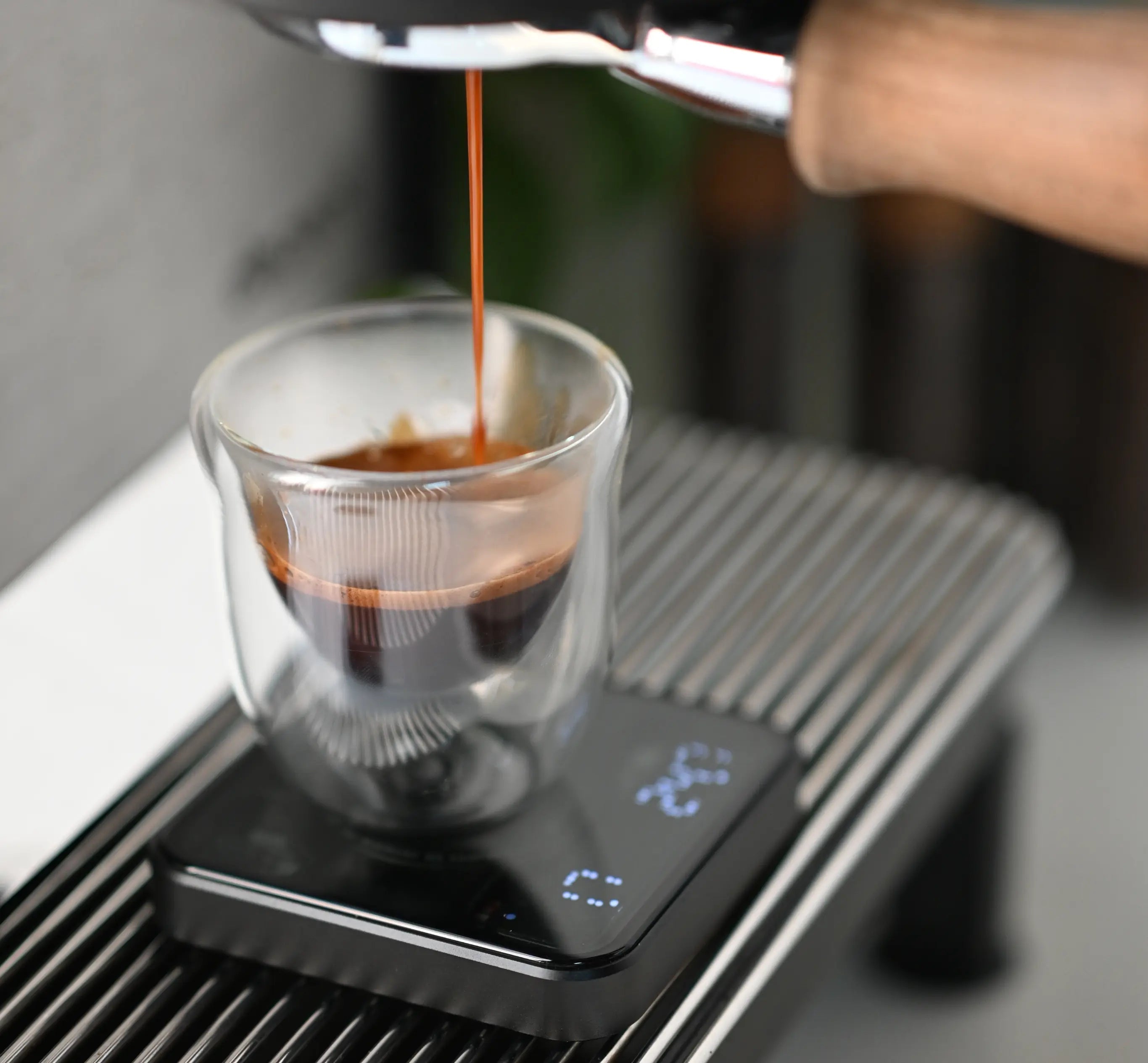
Is it really as simple as a basic calculation of "weight / time"?
One of the most fascinating—and frustrating—experiences in making coffee is the “unrepeatable perfect cup.”
You’ve probably been there: the same dose, the same grind size, the same tamping pressure, and the timer stops precisely at 30 seconds. Yet the bright, fruity notes from yesterday suddenly turn into an unexpected bitterness.
Why does the taste change when all the parameters remain the same?
The truth is, average data can be misleading. Those final "30 seconds" only tell the outcome, while the real answer lies in how water flows through the coffee bed every second.
Did channeling occur at a critical moment? Did fines clog the filter later in the extraction? These invisible fluctuations are what make flavor so unpredictable.
In this article, we’ll cut through the illusion of "average flow rate" and unpack the “black box” of extraction through the lens of flow rate.
In this article, you’ll learn:
-
The fundamental logic of coffee flow rate
-
Why flow rate fluctuates during extraction
-
How flow rate shapes flavor and balance
-
The diagnostic value of real-time flow rate
-
Why professional coffee scales need a flow rate mode
-
How BOOKOO Themis Scales translate extraction through advanced algorithms
1. The Logic of Coffee Flow Rate
Coffee flow rate refers to the weight of liquid coffee extracted per unit time ( g/s ) . In practice, it’s important to distinguish between water input and beverage output.
1.1 Two Key Metrics
-
Water Flow (Input): The amount of water delivered by the machine or kettle.
-
Real-time Flow Rate (Output): The rate at which coffee drips into the cup.
-
Core Principle: Flow rate = f(water input, puck resistance)
1.2 Scenario Differences
-
Pour-over: Balance of Gravity and Percolation
-
Flow rate is influenced by bed permeability (grind size, degassing) and filter permeability.
-
The logic: If water input exceeds permeability, the water level rises, increasing pressure and slightly accelerating flow.
-
-
Espresso: Dynamic Changes Under Pressure
-
The machine pushes water at a constant pressure (e.g., 9 bar).
-
The logic: Flow rate is dynamic—slow at the start due to a dense puck, then speeds up as solubles dissolve and resistance decreases.
-
2. Why Does Flow Rate Fluctuate? — What’s Really Controlling It

Flow rate isn’t random—it’s the real-time result of force vs. resistance inside the coffee bed. These factors fall into three groups:
2.1 Structural Resistance (Set Before Brewing)
These define the baseline flow behavior:
-
Grind size (key variable): Finer grind → larger surface area, narrower pathways → sharply higher resistance
-
Dose & bed depth: Higher dose → longer path → more friction
-
Tamping (espresso): Higher density → less space for water to pass through → higher resistance
2.2 Dynamic Variables (During Extraction)
Harder to control, and often the cause of instability:
-
Pour disturbance (pour-over): Higher pour height or stronger flow adds force and can disrupt bed structure
-
Fines migration & filter clogging: Fines settle and block pores → common cause of mid-to-late stage slowdown or stalling
-
Air resistance (degassing): Poor airflow (e.g., filter paper sticking tightly to the dripper wall) traps CO₂ → counteracts gravity → flow slows down
-
Channeling: Water finds weak paths → sudden spike in flow rate
2.3 Physical Conditions
-
Water temperature: Higher temp → lower viscosity → slightly faster flow
-
Pump flow rate (espresso): Higher input flow → stronger force on the puck → higher flow rate
💡Key Takeaways:
- To slow down flow: Go finer with your grind, increase the dose, or tamp firmer (consider adjusting one or a combination of factors).
- Unexpectedly fast flow? Check for channeling.
- Unexpectedly slow flow? Check for fines migration or trapped air from CO₂.
3. Flow Rate & Flavor: Is There an Ideal Extraction Window?
Flow rate essentially controls the effective contact time between water and coffee grounds, directly affecting extraction yield and the resulting mouthfeel.
3.1 The Extraction Quadrant: How Flow Shapes Flavor
Both pour-over and espresso have an optimal extraction range where flow ensures balanced, smooth flavor. Too fast or too slow, and under-extraction or over-extraction occurs.
| Flow Profile | Time range | Extraction Status | Flavor Profile | Reasons |
| Too Fast | <20s(espresso) / <1.5min(pour-over) | Under-extracted | Sour, thin, lacking sweetness. | Short contact time extracts only easily soluble acids; sweetness is under-extracted. |
| Ideal range | 20–30s(espresso) / 1.5–3min(pour-over) | Balanced | Balanced acidity with pronounced sweetness, a smooth body, and clean, well-defined flavor separation. | Even water flow extracts desirable flavors while avoiding bitterness—ideal extraction. |
| Too Slow | >40s(espresso) / >3min(pour-over) | Over-extracted | Bitter, astringent, dry, "burnt" notes. | Long contact time extracts excessive bitter compounds (e.g., chlorogenic acids, caffeine), causing over-extraction. |
3.2 More Important Than Average Speed: Flow Consistency
Even if total brew time is in the golden range, large fluctuations in flow rate can ruin the cup.
Common flow curve “symptoms”:
-
Sudden spike (Channeling):
-
Observation: Flow rate spikes mid-extraction.
-
Effect: Water bypasses parts of the bed → over-extraction along channels and under-extraction elsewhere
-
Flavor: Harsh bitterness combined with thin acidity
-
-
Abrupt slowdown (Clogging effect):
-
Observation: Flow curve drops suddenly or flattens early
-
Effect: Fines migration or excessive compaction → uneven flow and stalling
-
Flavor: Burnt, woody notes; heavy, dull mouthfeel
-
-
Geek-approved “ideal curve”:
-
Pour-over: Apart from brief fluctuations during pouring, flow should rise and fall smoothly under control
-
Espresso: After pre-infusion, flow should increase steadily, then maintain a gentle slope until extraction ends, with no sudden pulses
-
💡Key Takeaways:
The smoother the flow, the more uniform the resistance across the bed. When every particle receives a consistent amount of water for the same duration, flavor achieves maximum clarity and balance.
4. Real-time Flow Rate: Moving from "Results" to "Process"
Traditionally, brew quality was judged by average flow rate (total weight / total time). But averages often mask critical issues happening during extraction.
-
Espresso example: 18 g of coffee yields 36 g of liquid in 30 s (average flow 1.2 g/s ). Looks perfect—but if nothing comes out in the first 10 s and the last 20 s spike to 1.8 g/s, the shot likely suffers from severe channeling.
-
Pour-over example: Total brew time 2 min 30 s. If early overpouring causes pooling and later fine grounds clog the filter, the resulting flavor can be chaotic despite a “normal” average flow rate.
Valuable Insights into Real-time Flow Rate
-
Espresso: See inside the puck like an X-ray.
-
Pre-infusion: Ideal flow is very low and stable (even just a few drops). A sudden spike indicates a loose puck or early channeling.
-
Mid-to-late extraction: Flow naturally rises as solubles dissolve and resistance drops. A sharp drop signals over-compression or fines blocking the pores.

-
Pour-over: The Tug-of-War Between Input and Output
In manual brewing, we focus on how water input drives output flow in real-time:
-
Input flow (water in): Reflects pouring stability. Too fast can push fines toward the filter bottom, disrupting the bed.
-
Output flow (coffee out): Reflects puck permeability.
-
Key observation: Compare input vs output.
-
If pouring stops and output drops immediately → puck drains too quickly (grind too coarse)
-
If output lingers after pouring stops → water is “stuck,” indicating pooling or clogging
-

💡 Key Takeaways
-
Average flow rate only verifies the outcome (did total extraction time hit the target?).
-
Real-time flow rate tracks the extraction process, revealing puck collapse, channeling, or clogging—the only parameter that shows deviations as they happen.
-
Extraction quality depends on the linearity of the flow curve, not total time. Any unexpected slope change (pulse or cliff) → uneven water distribution → local over-extraction + overall under-extraction → unbalanced flavor.
5. Why Do Professional Coffee Scales Need a Flow Rate Mode?
5.1 The Technical Challenge of Flow Rate Mode
Since real-time flow rate is the only dynamic window into extraction, a coffee scale is no longer just a static weighing device—it becomes a real-time data collection device.
On a professional scale, flow rate mode isn’t just about displaying numbers; it’s about providing extraction insights. Users can see how the puck evolves the moment water hits, allowing them to adjust grind, tamping, or pouring technique on the fly.
But the challenge is: is flow rate really just weight / time ?
-
Simply dividing weight by time produces noisy readings. Tiny sensor vibrations or the impact of falling water can cause spikes, making the data unreliable.
A truly professional flow rate mode solves two core engineering problems:
-
High-frequency sampling & stability (The Balance of Sensitivity): How to capture tiny weight changes quickly without letting water splashes or vibrations distort the curve?
-
Algorithmic interpretation (Data Interpretation): How to transform raw numbers into a smooth, readable, and real-time curve for actionable insights?
5.2 BOOKOO Themis Scale Solution: More Than Display—It “Translates” Extraction

When designing the Themis series, BOOKOO made Flow Rate mode more than just a UI feature — it’s powered by advanced algorithms. The goal isn’t to show a number—it’s to let users truly understand the extraction process.
-
Instant response: High-precision sensors and high-speed processing chips capture every millisecond of flow fluctuation accurately.
-
Intelligent filtering algorithms: Differentiates transient spikes from gradual trends, applying adaptive filtering to preserve responsiveness while minimizing noise.
-
Insightful interaction: Abstract flow ( g/s ) is converted into intuitive visual feedback, allowing users to read the extraction, not just watch a jumping number.
6. Behind the Tech | How BOOKOO’s Proprietary Algorithms Make Flow Curves Smooth and Stable?
To make flow rate data both smooth and precise, the BOOKOO Themis series employs a sophisticated algorithmic design. This is a systemic engineering challenge that requires the simultaneous optimization of sampling, calculation, filtering, and visual rendering.
We sat down with BOOKOO’s lead engineers to discuss the logic behind the technology.
Q1: Coffee Flow Rate—isn’t it just weight / time ?

Engineer: That’s a very common misconception. What you’re describing is mathematically known as “static differentiation.”
Most kitchen scales or entry-level coffee scales follow a static weighing approach—they sample at a very low rate (around 2–5 Hz) and simply calculate (current weight – previous weight) ÷ time.
The problem is, this method fails in practice. The data is coarse and misses key extraction details, small disturbances cause large spikes, and there’s noticeable delay—it reflects past averages, not true real-time flow.
Q2: What algorithm does BOOKOO’s Themis Scales use?
Engineer: Well, traditionally you’d use a Derivative Algorithm to calculate the instantaneous slope. Mathematically it works, but in real coffee extraction, it just doesn’t.
Why? Because derivatives are extremely sensitive to noise. Even small things—water droplets hitting the scale, tiny vibrations, or air currents—get amplified, and suddenly your flow rate curve looks like a jagged sawtooth.
So for Themis, we didn’t rely on a plain derivative. Instead, we combine recursive algorithms with low-pass filtering—this way, the curve stays smooth and meaningful, even with all the real-world noise.
Q3: What are “recursive derivative” and “low-pass filter”? What advantages do they have over traditional methods?
Engineer: You can think of this combo as a smart translator—it takes noisy signals and turns them into something readable.
A recursive derivative works over a short time window (around 0.3–0.5 seconds), so brief spikes don’t immediately affect the result. That helps suppress high-frequency noise and keeps the flow more continuous.
And low-pass filter. It constantly references both current and past data, reducing the impact of sudden anomalies—like water droplets hitting the scale. Instead of reacting to every change, it builds a smooth trend over time.
In simple terms, the process is: raw weight → smoothing → then flow calculation. The result is a curve that’s stable, responsive, and much more reliable in real-world use.
Q4: Why does Themis also offer a “Flow Smoothing” function?
Engineer:
That’s for users who want an even cleaner view.
We already smooth the weight data by default. With Flow Smoothing, we add another layer of filtering on the flow rate itself.
So it’s really about preference— leave it off if you want the most immediate, real-time feedback, or turn it on if you prefer a smoother, more intuitive view of the overall trend.
Q5: Why don’t most coffee scales do this?
Engineer: Honestly, because it’s hard—and expensive.
To make real-time flow actually work, you need better sensors, faster sampling, and enough processing power to handle everything on the fly. And even then, tuning is tricky—too much filtering adds delay, too little and the data just jumps around.
So most brands stick to stable weight display. But We decided to go further.
7. Conclusion: From Intuition to Data-Driven Brewing
Flow rate is the key variable that connects your grind, tamping, and pouring to the final flavor in the cup.
Traditionally, brewers could only rely on "Total Time" to guess what happened during extraction. The BOOKOO Themis Series changes this by using proprietary algorithms to provide stable, real-time flow data.
We believe that every 0.1 g/s fluctuation represents a physical change within the coffee bed. Our goal is to use underlying algorithm engineering to "translate" complex physical signals into actionable data, helping users identify channeling or clogging as they happen.
Mastering flow rate means mastering the consistency of your coffee.
Share:
Espresso Pressure Guide: 6 vs 9 vs 12 Bars Compared
BOOKOO Motto 80 Production Update: July 2026